

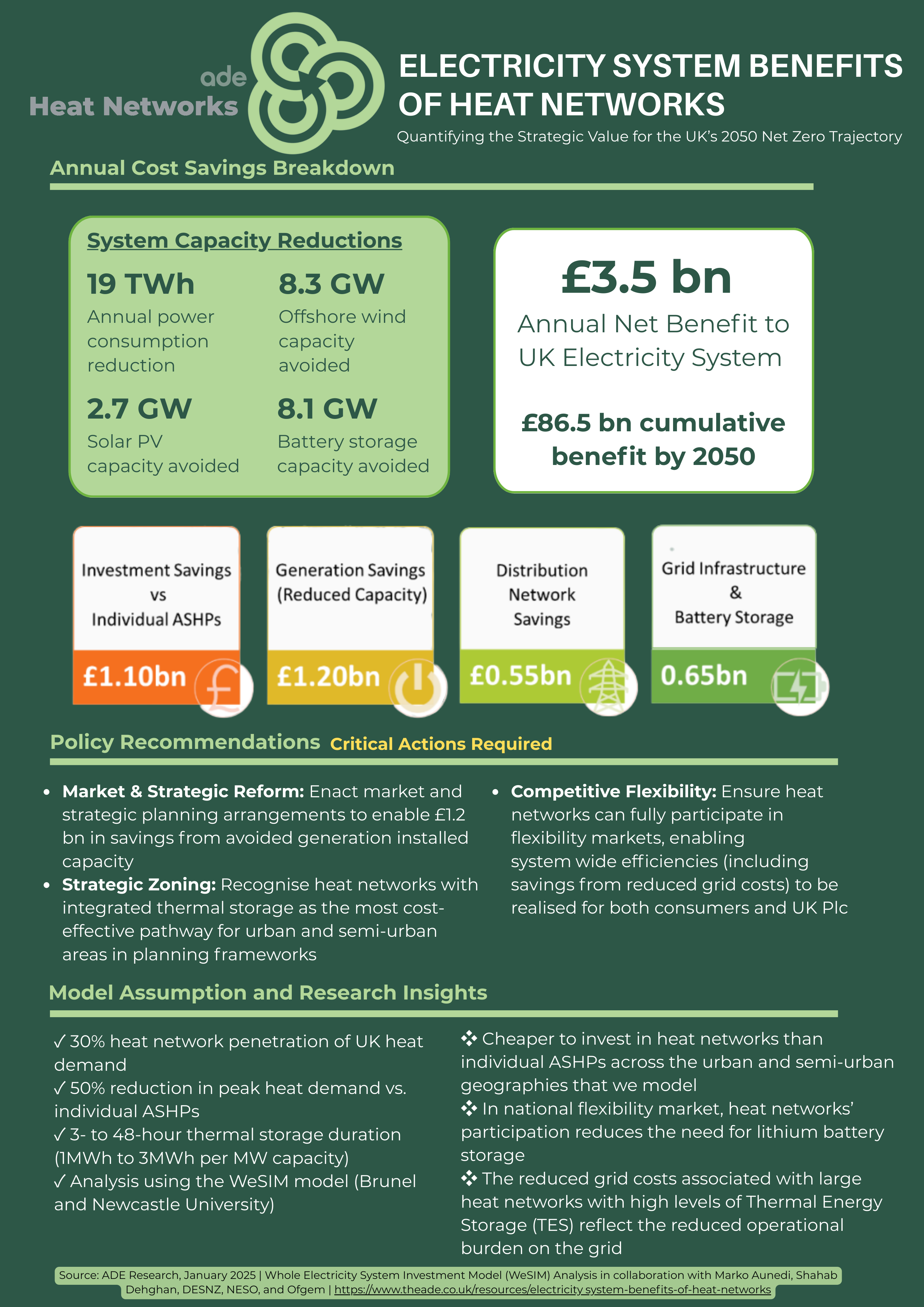
Heat networks will deliver billions in annual cost savings for the UK – no matter how fast battery prices fall or how quickly they roll out – according to groundbreaking research by the ADE. The study reveals that heat networks could save £3.46 billion a year, with cumulative savings of £86.6 billion by 2050. Even modest deployment could save £1 billion a year, rising to £6.45 billion if ambitious deployment is coupled with similar ambition across the energy sector. In this scenario, cumulative savings could hit a staggering £161 billion by 2050.
The ADE’s analysis, backed by government, industry and academic experts, delivers clear results. The study finds that heat networks slash energy generation costs and require less investment than individual air source heat pumps in every scenario tested. Holding all costs equivalent across the model and the counterfactual, we find annual net savings of £3.46 billion, including £1.2 billion in generation cost savings, and that it is £1 billion a year cheaper to invest in heat networks over individual Air Source Heat Pumps. Crucially, in this scenario we also see £2.4 billion a year in savings for the broader electricity system, including half a billion in annual distribution savings.
Assuming an ambitious roll-out of heat networks with low battery costs causes these benefits to skyrocket still further, to £6.45 billion in annual net savings, including £7 billion from more efficient energy generation.
Freddie Wilkinson, ADE Senior Researcher, said “The numbers don’t lie, heat networks are the solution. Whether we go big or start small, these systems cut costs, year after year. Heat networks are key to an energy system that pays us back. Every pound saved is a pound for schools, hospitals, or cutting bills. The faster we act, the faster we win.”
The research highlights heat networks’ unique ability to reduce strain on the grid, even without major tech breakthroughs. Large networks connected to a smart electricity grid save £2.4 billion annually for the broader electricity system, increasing to £5.7 billion in scenarios with ambitious retrofit and low battery costs. Remarkably, in these scenarios networks still save £2.7 – £5.9 billion a year, even when the model removes their known ability to smooth out peaks in demand, proving their resilience to uncertainty.
The ADE urges policymakers to prioritise heat networks in net-zero plans, stressing their unmatched potential to future-proof the UK’s energy landscape.
For further interview or comment, please contact external.affairs@theade.co.uk.
About ADE Heat Networks
ADE Heat Networks is the leading trade body for the heat networks sector. We have over 160 member organisations and together we are championing the role of heat networks in the green transition.
For further information please contact:
Pablo John
Head of External Affairs
ADE: Heat Networks
Pablo.john@theade.co.uk
Download Electricity System Benefits Of Heat Networks ADE Research